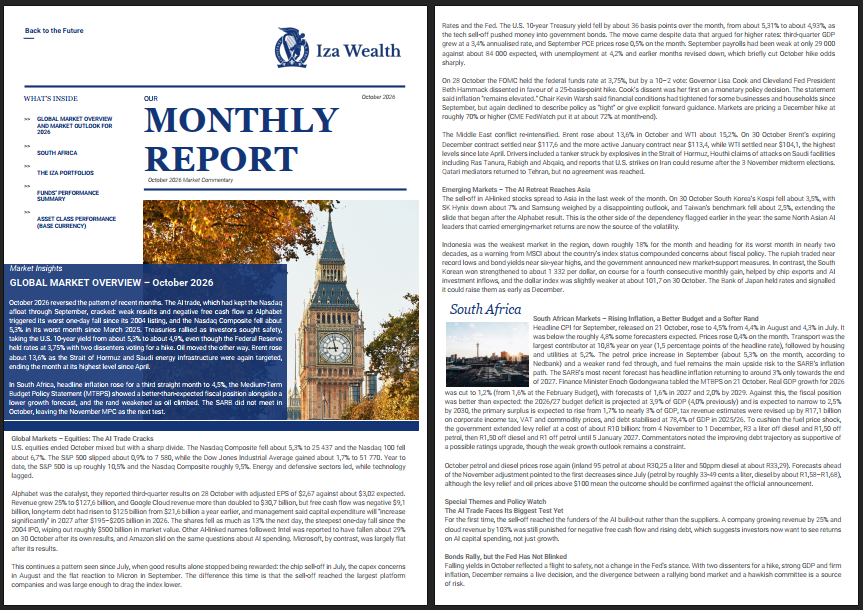
Our report is available below
Click the image to view/download the PDF
Market Insights
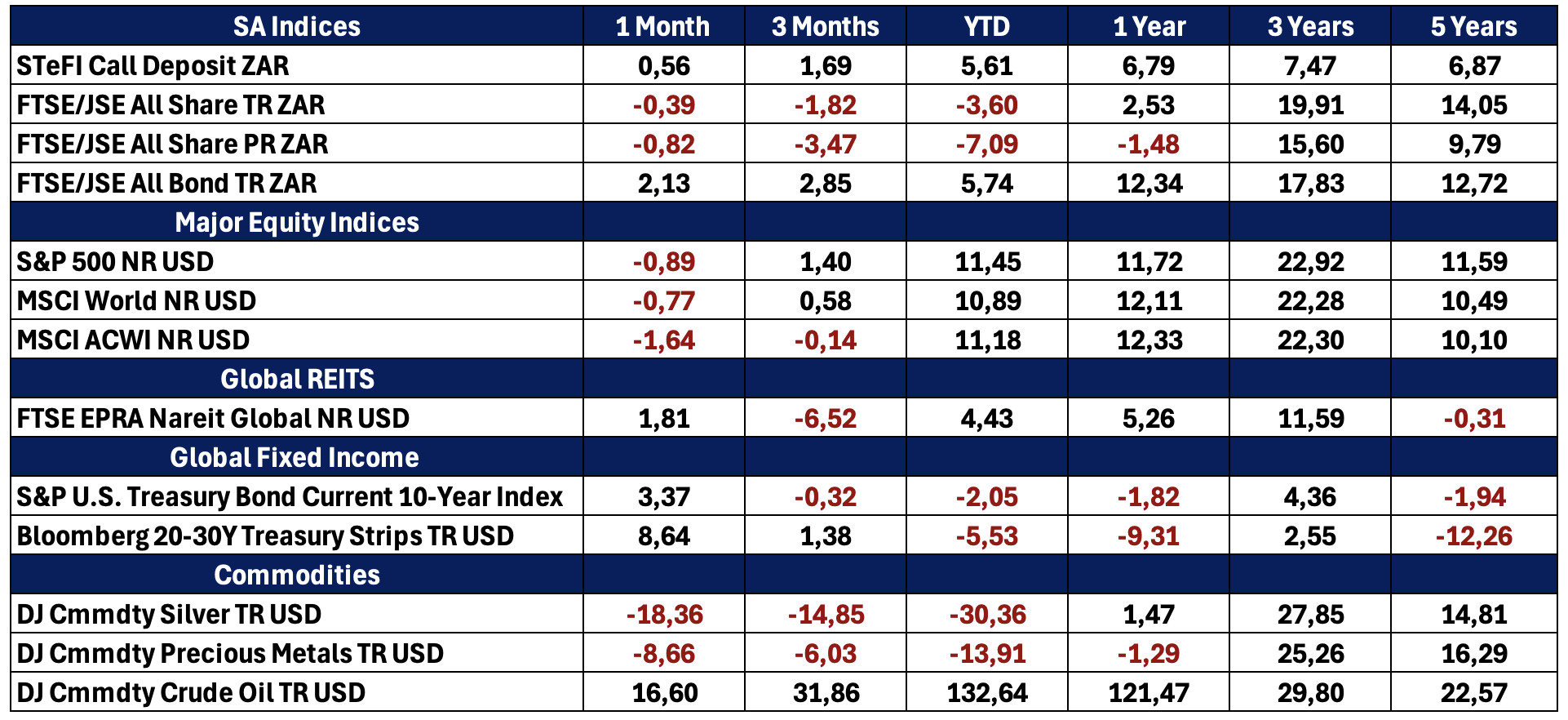
 October 2026 reversed the pattern of recent months. The AI trade, which had kept the Nasdaq afloat through September, cracked: weak results and negative free cash flow at Alphabet triggered its worst one-day fall since its 2004 listing, and the Nasdaq Composite fell about 5,3% in its worst month since March 2025. Treasuries rallied as investors sought safety, taking the U.S. 10-year yield from about 5,3% to about 4,9%, even though the Federal Reserve held rates at 3,75% with two dissenters voting for a hike. Oil moved the other way. Brent rose about 13,6% as the Strait of Hormuz and Saudi energy infrastructure were again targeted, ending the month at its highest level since April.
In South Africa, headline inflation rose for a third straight month to 4,5%, the Medium-Term Budget Policy Statement (MTBPS) showed a better-than-expected fiscal position alongside a lower growth forecast, and the rand weakened as oil climbed. The SARB did not meet in October, leaving the November MPC as the next test.
Global Markets – Equities: The AI Trade Cracks
U.S. equities ended October mixed but with a sharp divide. The Nasdaq Composite fell about 5,3% to 25 437 and the Nasdaq 100 fell about 6,7%. The S&P 500 slipped about 0,9% to 7 580, while the Dow Jones Industrial Average gained about 1,7% to 51 770. Year to date, the S&P 500 is up roughly 10,5% and the Nasdaq Composite roughly 9,5%. Energy and defensive sectors led, while technology lagged.
Alphabet was the catalyst, they reported third-quarter results on 28 October with adjusted EPS of $2,67 against about $3,02 expected. Revenue grew 25% to $127,6 billion, and Google Cloud revenue more than doubled to $30,7 billion, but free cash flow was negative $9,1 billion, long-term debt had risen to $125 billion from $21,6 billion a year earlier, and management said capital expenditure will “increase significantly” in 2027 after $195–$205 billion in 2026. The shares fell as much as 13% the next day, the steepest one-day fall since the 2004 IPO, wiping out roughly $500 billion in market value. Other AI-linked names followed: Intel was reported to have fallen about 29% on 30 October after its own results, and Amazon slid on the same questions about AI spending. Microsoft, by contrast, was largely flat after its results.
This continues a pattern seen since July, when good results alone stopped being rewarded: the chip sell-off in July, the capex concerns in August and the flat reaction to Micron in September. The difference this time is that the sell-off reached the largest platform companies and was large enough to drag the index lower.
Rates and the Fed. The U.S. 10-year Treasury yield fell by about 36 basis points over the month, from about 5,31% to about 4,93%, as the tech sell-off pushed money into government bonds. The move came despite data that argued for higher rates: third-quarter GDP grew at a 3,4% annualised rate, and September PCE prices rose 0,5% on the month. September payrolls had been weak at only 29 000 against about 84 000 expected, with unemployment at 4,2% and earlier months revised down, which briefly cut October hike odds sharply.
On 28 October the FOMC held the federal funds rate at 3,75%, but by a 10–2 vote: Governor Lisa Cook and Cleveland Fed President Beth Hammack dissented in favour of a 25-basis-point hike. Cook’s dissent was her first on a monetary policy decision. The statement said inflation “remains elevated.” Chair Kevin Warsh said financial conditions had tightened for some businesses and households since September, but again declined to describe policy as “tight” or give explicit forward guidance. Markets are pricing a December hike at roughly 70% or higher (CME FedWatch put it at about 72% at month-end).
The Middle East conflict re-intensified. Brent rose about 13,6% in October and WTI about 15,2%. On 30 October Brent’s expiring December contract settled near $117,6 and the more active January contract near $113,4, while WTI settled near $104,1, the highest levels since late April. Drivers included a tanker struck by explosives in the Strait of Hormuz, Houthi claims of attacks on Saudi facilities including Ras Tanura, Rabigh and Abqaiq, and reports that U.S. strikes on Iran could resume after the 3 November midterm elections. Qatari mediators returned to Tehran, but no agreement was reached.
Emerging Markets – The AI Retreat Reaches Asia
The sell-off in AI-linked stocks spread to Asia in the last week of the month. On 30 October South Korea’s Kospi fell about 3,5%, with SK Hynix down about 7% and Samsung weighed by a disappointing outlook, and Taiwan’s benchmark fell about 2,5%, extending the slide that began after the Alphabet result. This is the other side of the dependency flagged earlier in the year: the same North Asian AI leaders that carried emerging-market returns are now the source of the volatility.
Indonesia was the weakest market in the region, down roughly 18% for the month and heading for its worst month in nearly two decades, as a warning from MSCI about the country’s index status compounded concerns about fiscal policy. The rupiah traded near record lows and bond yields near six-year highs, and the government announced new market-support measures. In contrast, the South Korean won strengthened to about 1 332 per dollar, on course for a fourth consecutive monthly gain, helped by chip exports and AI investment inflows, and the dollar index was slightly weaker at about 101,7 on 30 October. The Bank of Japan held rates and signalled it could raise them as early as December.
South Africa

South African Markets – Rising Inflation, a Better Budget and a Softer Rand
Headline CPI for September, released on 21 October, rose to 4,5% from 4,4% in August and 4,3% in July. It was below the roughly 4,8% some forecasters expected. Prices rose 0,4% on the month. Transport was the largest contributor at 10,8% year on year (1,5 percentage points of the headline rate), followed by housing and utilities at 5,2%. The petrol price increase in September (about 5,3% on the month, according to Nedbank) and a weaker rand fed through, and fuel remains the main upside risk to the SARB’s inflation path. The SARB’s most recent forecast has headline inflation returning to around 3% only towards the end of 2027. Finance Minister Enoch Godongwana tabled the MTBPS on 21 October.
Real GDP growth for 2026 was cut to 1,2% (from 1,6% at the February Budget), with forecasts of 1,6% in 2027 and 2,0% by 2029. Against this, the fiscal position was better than expected: the 2026/27 budget deficit is projected at 3,9% of GDP (4,0% previously) and is expected to narrow to 2,5% by 2030, the primary surplus is expected to rise from 1,7% to nearly 3% of GDP, tax revenue estimates were revised up by R17,1 billion on corporate income tax, VAT and commodity prices, and debt stabilised at 78,4% of GDP in 2025/26. To cushion the fuel price shock, the government extended levy relief at a cost of about R10 billion: from 4 November to 1 December, R3 a liter off diesel and R1,50 off petrol, then R1,50 off diesel and R1 off petrol until 5 January 2027. Commentators noted the improving debt trajectory as supportive of a possible ratings upgrade, though the weak growth outlook remains a constraint.
October petrol and diesel prices rose again (inland 95 petrol at about R30,25 a liter and 50ppm diesel at about R33,29). Forecasts ahead of the November adjustment pointed to the first decreases since July (petrol by roughly 33-49 cents a liter, diesel by about R1,58–R1,68), although the levy relief and oil prices above $100 mean the outcome should be confirmed against the official announcement.
Special Themes and Policy Watch
The AI Trade Faces Its Biggest Test Yet
For the first time, the sell-off reached the funders of the AI build-out rather than the suppliers. A company growing revenue by 25% and cloud revenue by 103% was still punished for negative free cash flow and rising debt, which suggests investors now want to see returns on AI capital spending, not just growth.
Bonds Rally, but the Fed Has Not Blinked
Falling yields in October reflected a flight to safety, not a change in the Fed’s stance. With two dissenters for a hike, strong GDP and firm inflation, December remains a live decision, and the divergence between a rallying bond market and a hawkish committee is a source of risk.
Hormuz and Oil: Back Above $100
The month’s rise in oil reversed September’s diplomacy-driven fall. Markets are now pricing a risk of further escalation after the U.S. midterms, with analysts cited by market reports pointing to up to $120 if shipping attacks intensify and to about $80 if flows normalize.
Narrow Leadership Unwinds
The Nasdaq’s loss of more than 5% in a month in which the Dow gained shows the same concentration risk that made September’s headlines misleading, now working in reverse.
South Africa: Fiscal Progress, Weak Growth, Fuel Risk
The MTBPS gave the first real fiscal good news in some time, but growth of 1,2%, rising inflation and fuel levy relief that expires in stages leave the economy exposed to oil.
Closing Remarks
October showed that the forces which had been pressing on markets all year, expensive money, expensive oil and expensive AI, do not move together. This month the AI trade gave way, bonds rallied and oil climbed, producing a market that fell where it had been strongest and held up where it had been weakest. For South Africa, a better fiscal picture and a still-resilient currency were offset by rising inflation and a weak growth outlook, with the central bank’s next move looking increasingly like a question of oil. For investors, the message of the past five months holds and has become more pressing: diversification across both sectors and regions, attention to cash flow and balance-sheet quality, and humility about concentration in a handful of names matter more than ever.
The Iza Portfolios
Iza Global Balanced Fund
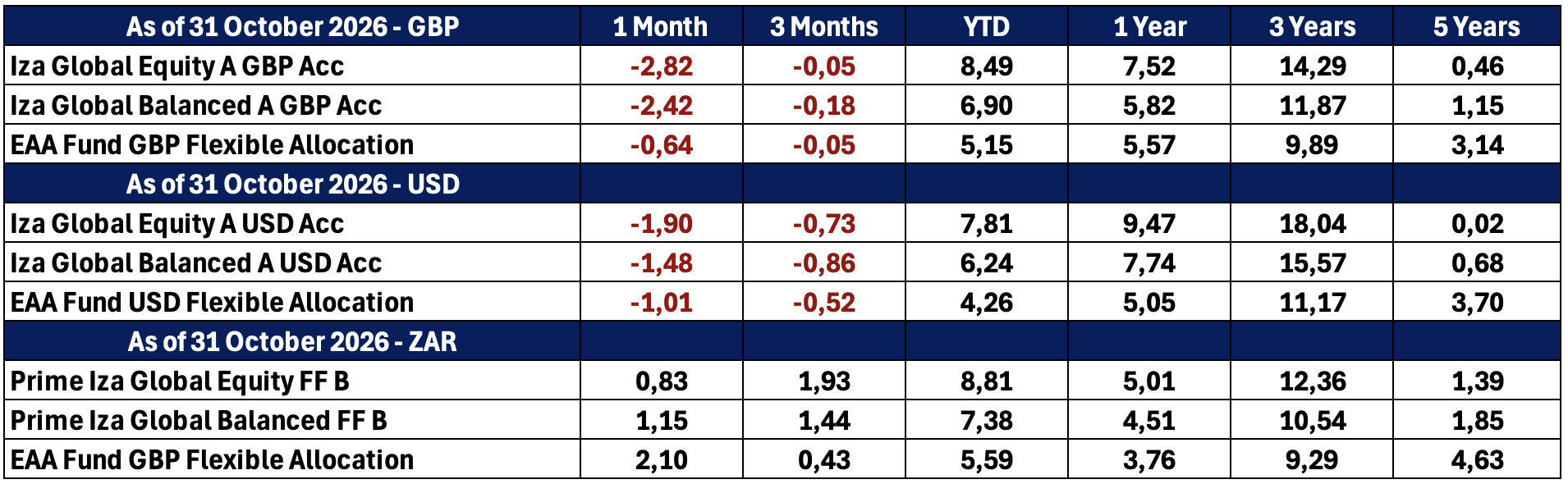
The Iza Global Balanced Fund delivered a return of -2,42% (GBP) and -1,48% (USD) during October, bringing its year-to-date return to 6,90% (GBP) and 6,24% (USD). Despite the decline during the month, the Fund continued to outperform its peer benchmark on both a monthly basis (benchmark returns of -0,62% (GBP) and -0,90% (USD)) and a year-to-date basis (benchmark returns of 4,99% (GBP) and 3,92% (USD)). Longer-term performance also remained ahead of benchmark, with Fund returns of 6,81% (GBP) and 8,63% (USD) over one year (versus benchmark returns of 5,56% (GBP) and 5,10% (USD)) and 18,38% (GBP) and 22,17% (USD) over two years (versus benchmark returns of 16,00% (GBP) and 17,09% (USD)).
October was a difficult month across the portfolio, with widespread weakness in gold, emerging markets and several growth-oriented equity strategies, only partially offset by resilience in the newly-added commodity exposure and select structured notes. The strongest performing underlying holdings during the month were the GS Note (Lindsell Train), delivering a positive return of 5,36%, the GS Note (Dodge & Cox Worldwide), delivering a return of 3,56%, and Ranmore Global Equity, delivering a return of 1,63%. The main detractors during the month were Templeton Emerging Markets, with a negative return of -9,43%, gold, with a negative return of -7,46%, reflecting a further pullback in precious metals, and the T Rowe Price Global Focused Growth Equity Fund, with a negative return of -8,04%.
Our top contribution to performance came from the GS Note (Lindsell Train), which contributed 0,03%, one of the few positive contributors in an otherwise difficult month. The main detractors to contribution were the T Rowe Price Global Focused Growth Equity Fund, which subtracted -0,62%, gold, which subtracted -0,23%, and Jupiter World Equity Fund, which subtracted -0,23%. The portfolio continues to maintain a balanced approach, combining growth opportunities with diversification through alternative investments, structured products, money market exposure and cash holdings.
Iza Global Equity Fund
The Iza Global Equity Fund delivered a return of -2,82% (GBP) and -1,90% (USD) during October, bringing its year-to-date return to 8,49% (GBP) and 7,82% (USD). The Fund modestly outperformed its benchmark, the MSCI ACWI Index, during the month in both currencies (benchmark returns of -2,46% (GBP) and -1,64% (USD)), though it remains behind on a year-to-date basis (benchmark returns of 10,83% (GBP) and 10,42% (USD)). The Fund had returns of 8,74% (GBP) and 10,59% (USD) over one year and 21,49% (GBP) and 25,38% (USD) over two years.
October was a difficult month for the Fund’s underlying managers, with sharp weakness in emerging markets and growth-oriented equity strategies offsetting continued strength in several of the newer, more diversifying allocations. The strongest performing underlying holdings during the month were Northstar Global Equity, delivering a positive return of 3,90%, Ranmore Global Equity, delivering a return of 1,63%, and the Artemis SmartGARP Global Equity Fund, delivering a return of 1,29%. The main detractors during the month were Templeton Emerging Markets, with a negative return of -9,43%, giving back a significant portion of its year-to-date gains, the T Rowe Price Global Focused Growth Equity Fund, with a negative return of -8,04%, and Guinness Global Innovation, with a negative return of -4,15%.
Our top contributions to performance came from Northstar Global Equity, which contributed 0,29%, and the Dodge & Cox Stock Fund, which contributed 0,06%. The main detractors to contribution were the T Rowe Price Global Focused Growth Equity Fund, which subtracted -0,62%, Templeton Emerging Markets, which subtracted -0,69%, and the MSCI World USD allocation, which subtracted -0,43%. The portfolio continues to maintain a multi-manager approach designed to deliver long-term outperformance of the MSCI ACWI Index, while managing short-term volatility through manager diversification.
Quote of the month
In the business world, the rearview mirror is always clearer than the windshield.
Warren Buffett
Funds’ Performance Summary
Asset Class Performance (Base Currency)